Monthly Archives: December 2008

Interested in Puerto Rican Home Movies of the 50s, 60s, or 70s

Hello, my name is Benilda Pacheco Beretta. I am doing an artistic research project called, A Mock Up of a Life Imagined: Recontextualizing a Puerto Rican Home movie and how it salvages the emotive past and the family histories. But I have been looking everyone especially in the internet archive for home movies dealing with Puerto Ricans. To say the least, it has been difficult, but I am hoping that maybe someone could give me some leads.

Hope the holidays goes well with your family and friends, and thank you for your time.

Benilda Pacheco Beretta

P.S. Check out some of my stuff on YouTube, http://www.youtube.com/user/berettabenilda

At Home in Two Traditions: Jazz and the Sounds of Puerto Rico

G. Paul Burnett/The New York Times
Miguelspan.jpg

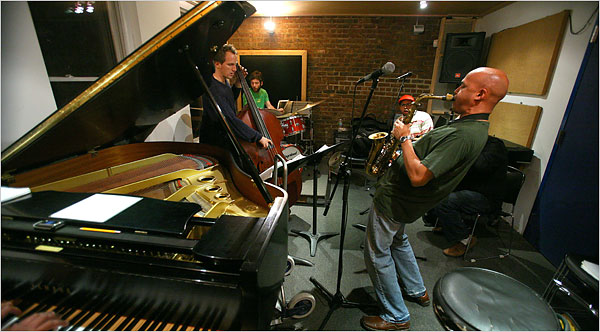
Miguel Zenón with his band, including the bassist Hans Glawischnig, the drummer Henry Cole and Obanilu Allende, in hat, who plays plena rhythms.
By BEN RATLIFF
Published: December 3, 2008

When the jazz saxophonist and composer Miguel Zenón visits his native Puerto Rico to see his mother and other relatives every year around Christmastime, he rarely hears any jazz. Instead he’s surrounded by plena, a century-old Afro-Caribbean musical tradition, a kind of movable street-corner folksong.
Miguel190.jpg

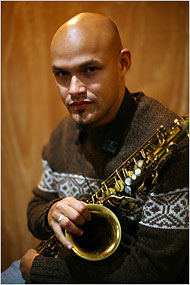
The composer and saxophonist Miguel Zenón.

Plena is made with three different-size panderos (like tambourines without the cymbals) and voices singing about island myths and scandals, cultural identity, political reality, love and plena itself.

“It’s really common,” he said in an interview last week in Washington Heights, where Mr. Zenón, 31, now lives with his wife, Elga Castro, a Ph.D. candidate in political science at the New School. “And it’s so simple that you find it at a basketball game, at church — anywhere.”

Panderos are easily portable, as opposed to the barrel-shaped drums used in bomba, another island music. And the four-beat plena rhythm has also been part of the holiday-season ritual of parranda, which is akin to Christmas caroling: surprise late-night musical visits to the neighbors.

Part of the jazz tradition is using whatever’s in front of you, and Mr. Zenón, a New Yorker since 1999, has done this before. His album “Jíbaro” (Marsalis Music), from 2005, dealt with the song form of Puerto Rican back-country troubadours, and it had a preoccupation with numbers, particularly in the décima, a 10-line stanza with specific rhyme schemes.

“Jíbaro” threads Puerto Rican folklore through small-group jazz played at a high level, led by Mr. Zenón’s limpid and graceful alto saxophone sound. The album helped establish Mr. Zenón as one of the important contemporary revisers of Latin jazz and spread his reputation for delivering excellent music from a complicated premise, a reputation that reached the secret committees of the MacArthur Foundation, which awarded him one of its $500,000 “genius” grants in September.

This year Mr. Zenón also received a Guggenheim research grant and took a long fact-finding trip back to Puerto Rico. To ask for introductions to the living plena masters, he sought out Hector (Tito) Matos, a plena practitioner who has played with the long-running New York band Los Pleneros de la 21, as well as his own group, Viento de Agua.

Mr. Matos pointed him toward historians and older musicians like Modesto Cepeda and Ismael (Cocolai) Rivera so that Mr. Zenón could understand the music’s origins and functions. He learned about the subtle differences, for instance, between the San Juan-style use of the open hand on the pandero and the slower-tempo “punta de clavo” fingertip style of Mayagüez.

An insight from Ramón López, an ethnomusicologist who has written about plena, helped Mr. Zenón with his work. “He said something to me about how the moment you put plena onstage, it’s not the real thing anymore,” Mr. Zenón said. “So he told me not to worry about it, because it’s already different from what it’s supposed to be.”

Mr. Matos said: “That he decided to focus on plena for a whole recording and a whole research project, that surprised me right away. It’s very important what Miguel is doing, to open the music we play to more ears around the world.”

Mr. Zenón used his research for his composition “Esta Plena,” a work in 10 parts: half instrumental, half with singing. (He wrote his own lyrics too: about the nature of plena, about an all-night New Year’s party at Mr. Matos’s house, about political corruption and the disappearance of cultural tradition.) It will be performed for the first time this week, Thursday through Sunday, at the Jazz Gallery in the South Village. The performances feature his working quartet — Mr. Zenón, the pianist Luis Perdomo, the bassist Hans Glawischnig and the drummer Henry Cole — as well as three extra musicians playing plena rhythms and singing: Mr. Matos, Juan Gutiérrez and Obanilu Allende.

Again in “Esta Plena” Mr. Zenón used numbers as an organizing principle. “There are three panderos in plena,” he said. “So I dealt with the number three. In terms of form I wrote a lot of phrases in three or six. Harmonically I started thinking in terms of major-third intervals and augmented triads, and from there I built melodies and chord progressions.”

That the basic plena rhythm is always in four — with the biggest drum accenting the one and three, the middle one accenting the three and four, and the smallest providing improvised accents — didn’t deter Mr. Zenón. Through “Esta Plena” he has kept the four-beat percussive plena rhythm steady, while writing melodic cycles for the rest of the band in three or nine.

If you think that sounds complex, you’re right. (Mr. Zenón graduated from Berklee College of Music in 1998 and had no formal math training beyond high school. Still, he has a math-and-science way of thinking.) Yet his compositions are always clear and organized, and when they’re making references to folklore, they keep the feeling of dance in them.

The number three, incidentally, has no other significance than the three panderos. Mr. Zenón laughed at the notion that it could signify the trinity. “When I write anything, I need something concrete to help me, something outside of music,” he explained. “On another project it might be letters.”

After the shows at the Jazz Gallery Mr. Zenón will record “Esta Plena” for his next album. And — given the financial freedom of the MacArthur award — then what?

He has an idea. Recently, he said, he was watching the documentary “Heima,” about how the Icelandic rock band Sigur Ros thanked the fans in its home country by playing an unusual series of free concerts: in factories, small-town community centers and even in fields and caves. Mr. Zenón said he got the urge to do something similar in Puerto Rico, particularly in small towns and mountainside areas where jazz is almost never heard.

It could make a difference, he said, to play jazz of the sturdiest sort; not his own, but music by Charlie Parker or John Coltrane or Miles Davis. He might also talk to audiences about improvising, play them records, offer clinics.

“When I grew up there,” he said, “there wasn’t really any live jazz. It was usually background music, and it was always the same eight or nine guys in San Juan. So I saw this movie, and I started thinking: man, if I could do that, just play the music, without having to worry about the business part — tickets, publicity, who’s going to pay the guys, are enough people going to show up — it would be incredible.”

Miguel Zenón performs Thursday through Sunday, 9 and 10:30 p.m., at the Jazz Gallery, 290 Hudson Street, South Village, (212) 242-1063, jazzgallery.org.
Which Side Are You On?

By SUZANNE VEGA

In the last few months I have had a chance to review a song I wrote in October of 2007. It’s called “Daddy Is White,” and I haven’t sung it out loud yet in front of an audience except to record a demo of it. My daughter worries that people might make fun of me. However, I feel that it is a truthful song.

In my last blog post I mentioned that I was raised in a half-Puerto Rican family and spent five years in East Harlem as a young child. At some point, when I was about 9 years old, I learned that my birth father was actually English-Scottish-Irish. Or white, as we used to say in my old neighborhood. Actually, anybody looking at me could probably tell that this was the case, but I felt I was the last to know, partly because I was treated by my Puerto Rican abuelita and my aunt and uncle as one of their own. I was proud, and still am proud, to be a Vega.

One person wrote in after my last blog entry to ask whether I had any plans to record Puerto Rican songs or songs in Spanish as a way of honoring those roots. I thought about this, but have to say no, even though I have had experience singing songs in Spanish. One of my first performing jobs was with a group called The Alliance of Latin Arts. I was 15 years old, and it was a government sponsored job, where we traveled from borough to borough singing songs in Spanish, like “La Bamba.” I attracted attention wherever I went, and it wasn’t because of my singing. (Somewhere in storage in a folder marked “scrapbook” I have a flyer from that job — when I find it I will post it here.) If you could look at the photo, you would see one girl in the line of dark-skinned Latinas to the far right looking down, and that is me, sticking out as usual.

It always struck me that in this picture I look like I am not only of a different race, but of a different century, as though I were Emily Dickinson and had somehow wandered into the Bronx in the 1970’s. (It should be noted that Puerto Ricans are not of one race — there are blue-eyed blond Puerto Ricans, though I never actually met any until recently.) I feel it would be false of me to do an album of Puerto Rican songs, since pretending I fit in, even back then, always felt a bit forced.

Songs brand us a part of a tribe. We can pick and choose what tribe we belong to. Goth, emo, hippie, punk, folk, alternative, for example. “Mom! Why are you wearing all black?” my daughter recently shouted at me. “You look so emo!” “I always wear black,” I mumbled. “But we are at the beach!” she said. Well, maybe she had a point.

I am of Irish descent, among other things, but I feel it would be false of me to perform traditional Irish music, even though I find some of it very moving. When I worked with Mitchell Froom, I liked that he said, “I will reveal you to be the mutant you really are!” when he heard how I grew up and about the mixed bag of stuff I grew up listening to — from Woody Guthrie and Phil Ochs to Motown, Lou Reed, Leonard Cohen and Bob Dylan. But perhaps one day I could do an album of Jewish folk songs in A-minor, or an album of cante jondo, which Federico Garcia Lorca wrote of; this would take guts. I love sad and tragic songs, and I love the sensuality of Brazilian bossa nova; perhaps my melancholic temperament could do justice to an album like this.

I remember walking down the street one day, wearing a Smiths t-shirt, back in the mid-’80s. I was headed for the subway station, and I had to pass through a crowd of black teenagers to get there. There were maybe eight or so young men, looking me up and down as I picked my way through them. My neck prickled with worry. What would they say? Would they call me a goofy white girl, or worse?

One of them snickered. My stomach dropped. Then another one sang out, “I am human and I need to be loved!! Just like everybody else does!!” Morrissey’s transcendental lyrics from “How Soon Is Now?” It was so unexpected that I burst out laughing. They knew the song! Then we all laughed, and the tension was broken. Maybe we were the same tribe after all.
* * *
ed-vega-guitar.jpg

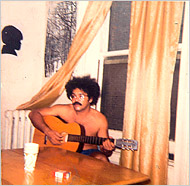
Ed Vega, circa 1972.
This song is called “Daddy Is White,” and I don’t know what tribe it represents. Maybe you also thought your daddy was Puerto Rican, and then you turned out to have another father! The song doesn’t even apply to my brothers and sister, whose daddy really was Ed Vega, who is shown here at the dining room table with the family guitar. However, the second and third verses were also drawn from reality — the second verse applies to the neighborhood I live in, where if you walk anywhere you run into the projects, where you can still feel those prickles, and feel all eyes on you: “What is she doing here?”

In the weeks following the recent election, though, there has been a very different feeling in the air in these neighborhoods, a feeling of relief, of recognition, of pride. There is going to be a man in the White House (Barack Obama) whose mother was white and whose father was black. He was a mixed-race child; he is a black man. His family is multicultural, as mine is. What a relief to see this represented in the realities of power and politics! In the media!

We say these words out loud and in print. Black, white. When I recorded the demo of this song earlier this year my engineer and I discussed what the song was about. At one point I realized we were whispering those words. Now we say them out loud, and they reflect our reality. It matters.

The last verse was inspired by a real-life discussion I overheard at a bar in Baltimore. A black man and a white woman were discussing a recent sports event. He called her “baby” playfully. She called him “stats boy,” meaning, I guess, someone well-versed in statistics. The conversation escalated quickly into a loud yelling argument, as he did not feel he was a boy of any kind and that word had racist overtones. Maybe the recent election means my song is on its way to being obsolete. I hope so.

Daddy Is White (By Suzanne Vega, 2007)

I am an average white girl who comes from Upper Manhattan.
And I am totally white, but I was raised half Latin.
This caused me some problems among my friends and my foes,
Cause when you look into my face, it’s clear what everybody else knows:

Chorus:
My daddy is white.
So I must be white too.
When you look into the mirror, what
Comes looking back at you?

If your daddy is white,
You must be white too.
When you look into the mirror
what comes looking back at you?

I feel it in the city when I take a walk uptown
I feel the tension in the air, I feel it ticking all around,
I feel it filling up the sidewalk, in the spaces in between,
Between my face and your face in public places where we get seen.

Chorus

He called her baby. She called him boy, and then it started.
They were strangers at the bar, and they both ended broken hearted.
And it was a conversation, but it ended as a fight.
And I can tell you it’s because he was black, and she was white.