
THE IMPRISONMENT OF MEN AND WOMEN FIGHTING COLONIALISM, 1898 - 1958 1940 - 1950 |

|
The 1930's end with several Nationalists serving terms of imprisonment in the United States for violating the Law of Servicio Militar Obligatorio (SMO) -- the military draft. Beginning in the 1940ís, nearly a hundred are jailed. Unlike World War I, the sentences vary between 1 and 5 years. Draft violators are accused of not registering, not going for a physical exam, not answering the call of the draft, not carrying their draft card. They are also arrested for encouraging the violation of the draft law, as in the case of the Nationalist leaders Ramon Medina Ramirez and Julio de Santiago. Mariano Juan Ramon Martinez is the first Nationalist to be arrested.
A total of 23 Nationalists are arrested in the first 2 years of the decade. Martinez
is arrested twice for violating the SMO laws. On the second occasion, he is accused
of not carrying his draft card. |
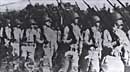
larger photo
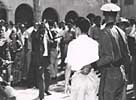 larger photo

| The number sentenced for draft-dodging rose to 20 and included other members of the Nationalist Party national committee: Julio de Santiago, Paulino Castro and Jose Rivera Sotomayor. |

|
This year is characterized by the arrest and jailing of Nationalists who had already served prison terms. A total of 16 are imprisoned. Of these, 11 had been jailed before. |

| Only 6 Nationalists are imprisoned. The same number as in 1945, the last year of
World War II. In New York, there are four cases of arrests for violating the draft. Three cases involve members of the Nationalist Party: Amaury Ruiz, Roberto Acevedo and Cesar B. Torres Rodriguez. The fourth case is journalist Rafael Lopez Rosas who had been sentenced earlier in Puerto Rico. During this period 7 men are arrested for draft-dodging and threatening the life of Judge Cooper, the judge who sentenced Puerto Ricans to prison most. Although the 7 men were not Nationalists, they are sympathetic to the political movement or to Albizu Campos. |

|
The SMO is only activated during times of war. A new law of obligatory
military service is approved after WWII. Six Nationalist youths are arrested for
violating this new draft law: Rafael Cancel Miranda, Ramon Medina Maisonave, Luis
M. OíNeill, Reinaldo Trilla, Dario Berrios and Miguel Angel Ruiz Alicea. They are
Nationalist Party cadets. Cancel and Medina Maisonave were sentenced to 2 years and
1 day. The others were sentenced to 1 year and a day for not registering. October 30
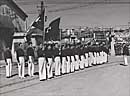
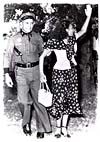
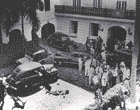
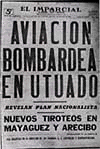
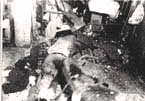
The revolutionaries go to Utuado, to the home of Nationalist leader Damian Torres where National Guard soldiers and airplanes attack them. Eleven Nationalists are killed and more than 20 are wounded.In Arecibo, Hipolito Mercado Diaz leads an attack on the police precinct. Four police officers and the Nationalist leader are killed.In Santurce, the National Guard and police attack a barber shopcalled El Boricua, where several revolutionaries were supposedly hiding. After three hours of crossfire, only one gravely wounded man Vicente Santiago, was found and shot dead. He alone had staved off the police and National Guard troops. |
 larger photo
 larger
photo
larger
photo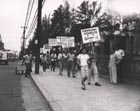 larger
photo
larger
photo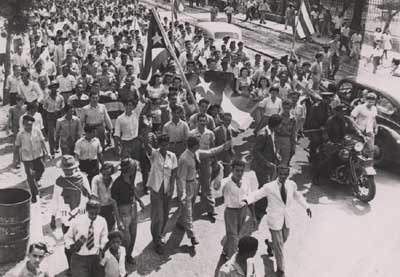 larger photo
 larger photo
 larger photo
 larger
photo
larger
photo